Translate

Search This Blog

Showing posts with label Buddhism. Show all posts

Friday, 5 September 2025

Blavatsky and Donald S. Lopez Jr. Buddhism

This is a critique of an academic paper, pointing out 34 problems, misconceptions, and mistakes. The reason I'm doing this is to try to clarify some fairly widespread problems in academia with regards to Blavatsky's relation to Buddhism. I'd basically like to argue that, although I don't have a problem with an academic adopting an eclectic approach to develop studies in a field outside of his diploma area of study, I think that it should be done in an organized, methodical way, as with, for example, the work of Christopher Lasch. In the case of Mr. Lopez Jr., his works on alternative spirituality seem to me to be informal sociological essays with little consultation of works of sociology, anthropology, history of religion and thus have significant flaws that are ultimately misleading in various ways, although I'm not questioning his credibility as a conventional Buddhism scholar and translator in the field of Buddhist studies per se. I've outlined some of the basic semantics issues with this kind of paper in a previous post about Theosophical history.
 
Orientalist vs. Theosophist by Donald S. Lopez Jr. Chapter 2 from  Imagining the East: The Early Theosophical Society Tim Rudbog (ed.), Erik Sand (ed.) (Oxford, 2020) Pages 37–58 February 2020
 
In this paper, Lopez Jr. comments on debates by H. S. Olcott and A. P. Sinnett with Max Müller.

 1- 'There he met the Russian émigré and medium, Helena Petrovna Blavatsky'(38).

Blavatsky never claimed to be a medium in spiritualistic terms and denounced such practices. (see 'Mr. A. Lillie's Delusions' [Light (London), Vol. IV, No. 188, August 9, 1884, pp. 323-324], Collected Writings, Vol. 6, p. 269)

2- 'among other things, would bring the teachings of the Buddha, at least as interpreted by the Society, to a large audience in Europe and America over the subsequent decades' (38).   

Henk Spierenberg’s The Buddhism of H.P. Blavatsky details how knowledgeable Blavatsky was about Buddhist texts and scholarship. Olcott lists a full bibiliography of respectable Buddhist texts in his Buddhist Catechism. 

3- 'He enthusiastically embraced his new faith, which he felt contained no dogma that he was compelled to accept' (38).  

Olcott and Blavatsky were earlier promoters of the Kalama Sutta as a document explaining non-dogmatic perspectives. 

4- 'The work was translated into Sinhalese and memorized by Sri Lankan children' (39).

'Colonel Olcott, together with Anagarika Dharmapāla of Ceylon, were pioneers in the Buddhist revival movement in India and Ceylon. They worked together in the development of Ceylon’s educational movement. They travelled from village to village on foot and in bullock cart, exhorting the people to live Buddhist lives, and collecting funds. Principally to the credit of Colonel Olcott there are about 12 large colleges and over 400 Buddhist schools in the island, which have now been handed over to the government under the recent nationalisation act' Dr. Buddhadasa & P. Kirthisinghe

5- 'he is remembered today as the founder of a Victorian “spiritual science”' (40).

Who remembers him as such? Aren Roukema calls him a ' journalist and occultist'.

6- Müller sought to dispel Olcott’s irrational fantasies (40).

What Müller considered as irrational fantasies.

7- Such was the confidence of the British Empire that Müller was not reluctant to tacitly acknowledge that the statues had been stolen from a Buddhist temple (41).

That's putting it mildly

8- Müller  politely declined an invitation to preside at the World’s Parliament of Religions in Chicago (42).

Also, the Theosophical Society had a ground-breaking participation at this event.

9- He thus finds it highly ironic that it was Buddhism, among all the other religions, that Madame Blavatsky selected as being somehow “esoteric”. (43)

Spends 1  1 /2 pages presenting Müller's critique of Blavatsky, without contextualizing Blavatsky's side, which is not presented. Even though the paper aims to present Müller-Sinnett debate, some brief notes on Blavatsky's position would seem to me to necessary for the sake of objectivity.

10- The first Mahatma she approached initially refused, but the second agreed, and between 1880 and 1885 Sinnett carried on a prodigious correspondence with the two most famous Mahatmas (43).

1880-85 correct? The correspondence ended in 1884. 

11- he was disappointed to have been passed over for the presidency of the London Lodge of the Theosophical Society; encouraged the membership to support his rival, Anna Kingsford (44).

The dispute in that case was resolved by creating a new lodge for Kingsford. Sinnett became president of the London Lodge afterwards. Later, Blavatsky formed another Lodge in London which attracted members from the London Lodge.

12-Sinnett goes on to explain that Madame Blavatsky’s aim, especially in Isis Unveiled, was not “to teach anything in particular, but to stir up interest in an unfamiliar body of occult mysteries.” (45).

The Sinnett-Blavatsky relationship is complex and significant, ye there are no explanations given. Again, even though the paper is about the Müller-Sinnett debate, it's a debate about Blavatsky, so a minimal reference to her positions would seem logical, for context's sake.

13- Müller is further mistaken in claiming that nothing of the secret teachings is present in the sacred books of the Buddhists (45).

The term Esoteric Buddhism has been accepted in academia and Tantric studies are thriving. Why not acknowledge this? 

14-He explains that “Common- sense ought to have been startled at the notion that the diet of so ultra- confirmed a vegetarian as a Hindoo religious teacher could not but be, could be invaded by so gross an article of food as roast pork. But worshippers of the letter which killeth are apt to lose sight of common- sense.” One might assume from this that Sinnett allies himself with the truffles camp. However, he offers another explanation (46)

Buddha’s last meal – The hermeneutic interpretation of that text was also advanced by Blavatsky with a similar interpretation (Secret Doctrine, Vol. 1, p. 368, fn).

15- One might justifiably ask at this point why this obscure exchange between two late Victorians, one an aged Oxford Sanskritist and the other, at least in view of some, an embittered spiritualist quack, should warrant our attention (47).

Sinnett maintained a respected position as International Vice-President of the Theosophical Society and maintained relations with public British figures and influenced later Theosophical developments, his subsequent reputation requires more study. He was quite successful in promoting what developed into the Neo-Theosophy of C.W. Leadbeater and Annie Besant. ‘Embitttered quack’ may not be an accurate.

16- For Sinnett’s Orientalism is heightened by the conceit that his knowledge derives from Aryan masters, communicating telepathically from deepest Tibet. But were they? (48)

The question of the mode of production of the Mahatma letters is a complex one and has been studied, see 

17- Adopting a different approach, the Theosophist K. Paul Johnson has sought to identify the numerous figures— Hindu, Buddhist, Masonic, Muslim, Parsi, Sikh, Indian, Egyptian, Persian, Sri Lankan, and at least one Tibetan— with whom Blavatsky and Olcott were associated during their travels (48).

Supports K. Paul Johnson’s groundbreaking work from thirty years  ago, which has  been criticized and considered untenable and outdated.

18- The Mahatma Letters (as well as Esoteric Buddhism and The Secret Doctrine) raises a host of questions about Orientalism and authority, perhaps the most outlandish of which is whether Madame Blavatsky’s ventriloquism somehow allowed the subaltern to speak (48).

The notion of ancient sages living in hiding and transmitting esoteric wisdom is not really an outlandish notion in Eastern countries, as Tibetan terma texts, and Tantric text in general, for example, widely attest.

19- Others, including such legendary fig­ures as Vivekananda and Dharmapala, after initially cordial relations with the Theosophists, would take exception to their claim that they could help Hindus and Buddhists “to know their religions better than heretofore” and would dis­avow any connection of their Hinduism and their Buddhism to Theosophy (49).

It’s a complex social question that requires more research. Studies have noticed Theosophical influences on Vivekananda. Theosophical influences on Dharmapala have been studied and his turn to a hard line nationalism has been criticized. For recent ground-breaking research on the question, see Julian Strube,  Global Tantra.

20- “Finally, I declare that I am completely opposed to the error of the modernists who hold that there is nothing divine in sacred tradition; or what is far worse, say that there is, but in a pantheistic sense, with the result that there would remain nothing but this plain simple fact— one to be put on a par with the ordinary facts of history” (51).

Comparing Sinnett to Pope Pius' X anti-modern views. Considering Blavatsky’s considerable writings criticizing the Catholic Church including PopePius IX, it seems strange that he would use such a quote to represent Theosophical views. Why not quote Blavatsky’s many critiques of modernism? Is he trying to portray Theosophists as traditionalists, despite Guénon?

21- ...his commitment to teaching the dharma to members of all castes— and identifies it as an error. At the same time, in an act of cosmic colonialism, he extracts the Buddha from the conven­tional chronology of history and places him in a different chronology unknown but to the initiates (51).

This is one of the most original notions presented in the early Theosophical teaching, which Blavatsky and T. Subba Row also wrote about. Blavatsky, for example in The Voice of the Silence, criticized Buddhist scholars for not using consistent spelling and definitions for Buddhist terms and concepts. The standardization of terminology since then has proven her criticisms to be valid. Asian Hindus and Buddhists are far from agreeing with the dating and historical explanations of modern Western religious scholars. For example, many would disagree with the rejection of Bodhidharma as an unhistorical legendary figure.

22- this act of interpretation was met by Asian teachers with bafflement or dismay (as in the case of Dayananda Saraswati) (52).

Does Lopez mean to reject esoteric symbolism in Buddhism altogether? Tantric studies have opened up the field of esoteric symbolism since at least Giuseppe TucciSaraswati attests to esoteric traditions that he has personally witnessed (Secret Doctrine, Intro, xxx).  

23- As European interest in Theosophy waxed, South Asian interest in Theosophy waned (52).

More could be said about the influence of Theosophy in South Asian countries. See chapter 2 in recent study, The making of Buddhism in modern Indonesia: South and Southeast Asian networks and agencies, 1900-1959 Yulianti (2020)

24- Sankara great persecutor of Buddhism (52).

What about studies of similarities of Shankara and Buddhism? 

25- The Theosophical Society continued to appropriate Buddhist doctrines (52).

This would imply a consistent, unified, linear development among various Theosophical organizations. But is this really the case? Many term certain developments in later periods as Neo-Theosophy and is incompatible with earlier Theosophy, but this paper does not take this documented view into account.

26- in 1909 as the future Buddha, Maitreya, the World Teacher of the Aquarian Age. (The boy, Jiddu Krishnamurti, renounced this status in 1929.) (52).

There is a pipeline from Sinnett to Leadbeater and Besant, but this is not explained. The fact the Maitreya notions contradict Blavatsky's original writings on the topic is not mentioned. Maitreya-Christ is a more technically accurate term. 

27-The American Theosophist, Walter Y. Evans- Wentz, discovered what he considered Theosophical doctrine in a Tibetan text that he would dub The Tibetan Book of the Dead (52).

Presenting a perfectly acceptable pioneering translation of an important Tibetan Buddhist text as some kind of exercize in adulteration and appropriation, while ignoring the fundamental role of Kazi Dawa Samdup, seems to me an exercize in reputation damage to Evans-Wentz at a level close to that of the Margaret Mead case.

28-But with few exceptions (Daisetsu Teitaro Suzuki called Madame Blavatsky’s The Voice of the Silence, “the real Mahāyāna Buddhism”), Buddhist figures did not reciprocate the interest of the Theosophists (52).

There are more than a few exceptions. See Blavatsky's Influence, Buddhism. There's also the question of Theosophy's influence on Buddhism in the 20th century, which has not been the subject of substantial research, to my knowledge.

29-Two decades later, he was more vociferous, writing in a letter of February 20, 1926, “Members of the Theosophical Society who follow [Charles W.] Leadbetter and Mrs. Besant are against Buddhism (52).

It would be useful to note that Dharmapala was more voiceferous because new teachings were presented that were in contradiction with previous Theosophical writings. 

30-the leading Buddhist monk in Sri Lanka, Hikkaduve Sumangala (1827– 1911), withdrew his imprimatur from the fortieth edition of Olcott’s Buddhist Catechism, declaring that seventeen of the answers were “opposed to the orthodox views of the Southern Church of Buddhism (52).

'Despite pressure from Dharmapala, Hikkaḍuve eventually responded favorably to an entreaty from Olcott (Prajñananda 1947, 2:778–79). Having reached an agreement with Olcott on revisions of the Catechism (Prothero 1996, 166), 62 he withdrew his resignation (Prajñananda 1947, 2:778– 79).'  Anne M. Blackburn, Locations of Buddhism: Colonialism and Modernity in Sri Lanka (Chicago: University of Chicago Press, 2010), p. 138. Why not mention that Sumangala had later taken exception to Olcott's questioning of the tooth relic of Gautama Buddha, as mentioned in the first part of the paper?

31- Buddhist figures did not reciprocate the interest of the Theosophists (52).

This is debatable. See 28.

32- was now rejected by the Buddhists as a modern creation (52).

Dharmapala's nationalism turn has been criticized, see 19. ”The path of perfection was shown to me by Mme Blavatsky in my 21st year”. (Diary, December 20, 1930); “Blavatsky gave me the key to opening the door to my spiritual nature”. (Diary, March 10, 1897) (quoted in Steven Kemper, Rescued from the Nation: Anagarika Dharmapala and the Buddhist World, University of Chicago, 2015. pp.53, 59)

33-But what became of the Orientalists, (53). 

The notion of Orientalist and Orientalism has been the subject of considerable historiographical research, a little more complex than noting that they continued to translate and study more Asian texts.

34- If we were to strip this traditional list of its myth­ological elements, as both Müller and the Theosophists, each in their own way, sought to do, the Buddha would be little more than a statue in Müller’s hearth (53). 

Since when does Blavatsky deny these traditional elements? See 2. For Theosophists to say that there are rational, hence relevant explanations behind legendary and mythological elements, whereas Mahayana at the time was facing strong rejection and modern Mahayana scholars generally adopt a skeptical non committal, albeit tolerant, outlook seems disingenuous (See 21, although Lopez Jr. himself is not quite so non commital, see 33).

Tuesday, 28 May 2024

Blavatsky and D. T. Suzuki, Daisetsu Teitaro, Daisetz

Daisetsu Teitaro Suzuki
(October 18, 1870 – July 12, 1966) was a Japanese author of books and essays on Buddhism, Zen and Shin that were instrumental in spreading interest in both Zen and Shin (and Far Eastern philosophy in general) to the West. His American wife, Beatrice Lane Suzuki, was a member of the Theosophical Society (Adyar) and played an important role in Japanese Theosophy.
Dr. Paul Carus befriended the Japanese Zen master Soyen Shaku (1859-1919), whom he met at the Parliament. After attending the Parliament Soyen traveled to Sri Lanka to study Pali and Theravada Buddhism for three years. At Carus's request Shaku also sent one of his students, Daisetsu Teitaro Suzuki, to the United States to translate Buddhist works for Carus's Open court Publishing Company. He also became close to Anagarika Dharmapala
 
Dr. Suzuki wrote about Blavatsky's book The Voice of the Silence: "Undoubtedly Madame Blavatsky had in some way been initiated into the deeper side of Mahayana teaching and then gave out what she deemed wise to the Western world..." He also commented: "Here is the real Mahayana Buddhism."
 
Ethics between East and West: Beatrice Erskine Lane Suzuki and Albert Schweitzer
 
Passing: Ms. Mihoko Okamura-Bekku (1935-2023)
Richard Jaffe
I write to convey the sad news that Ms. Mihoko Okamura-Bekku died in Kyoto on June 17, 2023 at the age of 88. Ms. Okamura, who was born and raised in the United States, was a student, assistant, secretary, and confidant of D.T. Suzuki from the early 1950s until Suzuki's death in 1966. Following Suzuki's passing, Ms. Okamura taught at Otani University, worked for the Japan Foundation, and served on the board of trustees for the Japan Folk Crafts Museum. She also lectured widely in Japan about Suzuki's life, Zen Buddhism, folk crafts, and traditional Japanese arts. Ms. Okamura was the co-author, with Ueda Shizuteru, of several books, some illustrated with numerous photographs she took, concerning her life and travels with Suzuki and his teachings. 
 
The Zen Buddhist Philosophy of D. T. Suzuki
Offering the first complete overview of Suzuki's approach, reputation, and legacy as a philosopher, this is for anyone interested in the philosophical relevance and development of Mahayana Buddhism today.
 

Zen’s Unassuming Pioneer
How the “Great Simplicity” of D.T. Suzuki popularized Zen in America
Rick Fields

D.T. Suzuki at the World Congress of Faiths in 1936
An Analysis of His Presentation at the Interfaith Conference
Journal of Religion in Japan 14 Jul 2021 
Compared to his early years and post-1949 lectures in the United States, as well as his English publications on Mahayana Buddhism, his half-year journey through Europe in 1936 is understudied. With limited access to primary sources in Japanese and English, previous studies tended to label him a “nationalist.” Instead, I analyze Suzuki’s discourses and other newly discovered primary sources from a historical perspective. Through this analysis, this paper will clarify Suzuki’s scheme to present Mahayana Buddhism, particularly Zen, to Westerners during the interwar period. 
 
Race and Zen  Julius Evola, Facism, and D.T. Suzuki 
Filippo Pedretti
Evola’s use of Daisetsu Teitarō Suzuki’s sources in his writings
(hereafter D. T. Suzuki), showing how Evola confronted their
Japanese nationalist/nativist elements, as well as their responses to
Japan’s encounter with Euro-American colonialism. 
https://www.google.ca/url?sa=t&source=web&rct=j&opi=89978449&url=https://arcjournal.library.mcgill.ca/article/download/293/309&ved=2ahUKEwjSupvEwJ2GAxWZGFkFHUlgCZUQFnoECBYQAQ&usg=AOvVaw1CNNPySN-S-wTPY2FuDncV  
 
D.T.Suzuki and Swedenborg: an Introduction.

EAST ASIAN NETWORK FOR THE ACADEMIC STUDY OF ESOTERICISM 2021
 
 
Good bio by Tsem Rinpoche, Feb. 14, 2018

Sunday, 19 May 2024

Blavatsky, Manga, Anime and Video Games

I'm not really that familiar with Japanes Manga and Anime, but who hasn't noticed the rise of popularity of this cultural export since the 1980s? With the success the Helena Blavatsky character in the Fate/Grand Order video game, I noticed a surprising amount of Theosophy-inspired characters, features and themes. Besides the basic eastern base of spiritual traditions, I notice that there is also a Japanese interest for western Victorian Gothic ideas, along with early western science-fiction, giving rise to the steampunk genre. Although there has been some academic study of religious influences in manga/anime, I don't think that there has been much research into Theosophical influences in the genre. Therefore this humble post proposes to sketch out some brief, rough notices of some of the more obvious instances that I've encountered, in a very informal way, which I think would make for some fun and interesting academic research.
 
1- Fate/Grand Order  is a free-to-play Japanese mobile game, developed by Lasengle (formerly Delightworks) using Unity, and published by Aniplex, a subsidiary of Sony Music Entertainment Japan. The game is based on Type-Moon's Fate/stay night franchise, and was released in Japan on 29 July 2015 for Android.
 
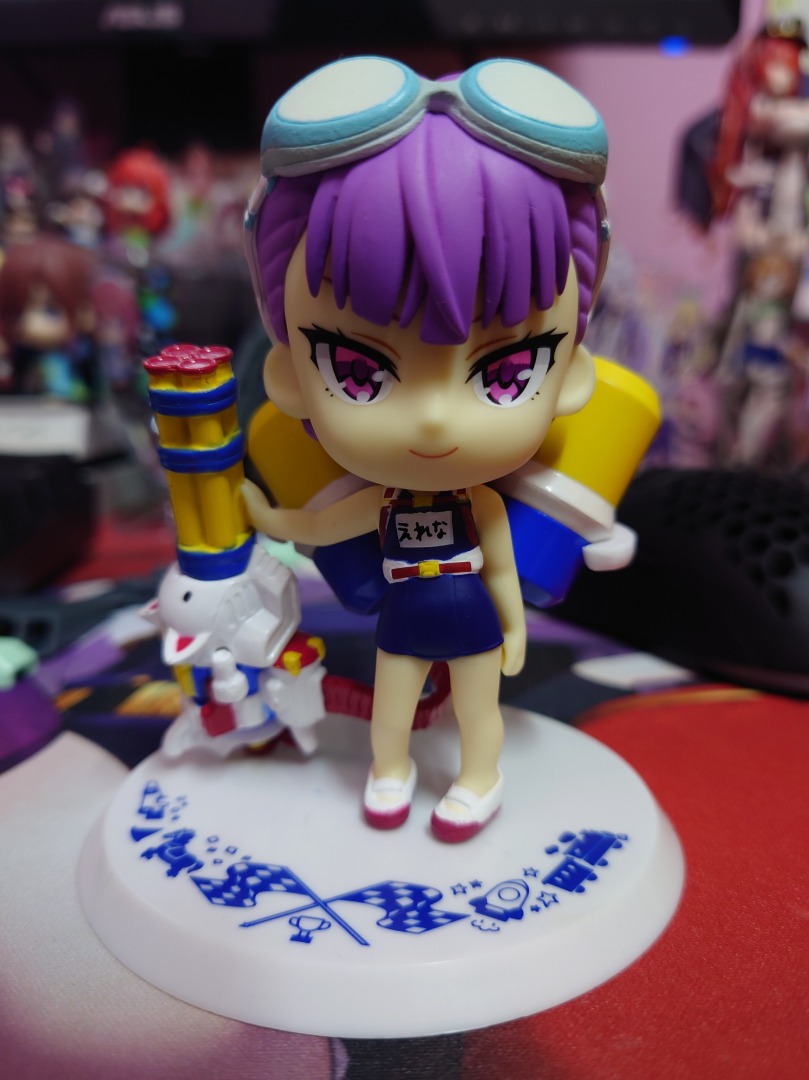
Figurine. That pet critter is Olcott
Young swimwear figurine


Special Winter Outfit
 Cosplay Portrayals


Blavat Sky
Blavatsky seems to have developed a fairly solid fan base. Some prominent successful merchandise include, a figurine, and a young beach swimsuit figurine. She has a special Winter outfit now.

2- There is also a character named Blavat Sky, a fortune teller and diviner at the Sphere Music Hall meetings
from Kuroshitsuji or Black Butler is a manga written and illustrated by Yana Toboso.
 
Koudelka Iasant


3-  Koudelka Iasant, main character in console role-playing game developed by Sacnoth and published by Aruze Corp in Japan and in the United States and Europe by Midway Games in 2001. In 1888, when Koudelka was nine years old, she was found in London by Mrs. Blavatsky, a renowned medium for the spirits. She raised Koudelka as her daughter, helping her hone her skills until she passed away in 1891. 
 
4- Aquarian Age is a Japanese collectible trading card game. The franchise now supports a PlayStation game, a manga, Juvenile Orion (2001), and a TV series; Aquarian Age: Sign for Evolution, as well as an animated film, Aquarian Age: The Movie, known in Japan as Aquarian Age Saga II: Don't forget me... (2003) and a live-action film, Aquarian Age: Juvenile Orion (2008)Five supernatural factions have been fighting against each other for who knows how many centuries, with the beginning of Aquarian Age always in mind. Kyouta, soon begins to see visions of mystical girls fighting, except they do exist. Soon he and his girlfriend Yoriko become involved and the battle for Earth and Aquarian Age lies in their hands. One of the characters is name Stella Blavatsky. 
 
Anna Bonus Kingsford
5- Theosophist Anna Bonus Kingsford appears in A Certain Magical Index, Toaru Majutsu no Indekkusu,  a Japanese light novel series written by Kazuma Kamachi and illustrated by Kiyotaka Haimura, a manga adaptation by Chuya Kogino began serialization in Monthly Shōnen Gangan since April 2007. J.C.Staff produced two 24-episode anime series between 2008 and 2011. An animated film was released in February 2013. A 26-episode third season aired between 2018 and 2019. Several spin-offs and other adaptations have also been made, including several video games.  
Bad Castelvania Saint Germain
6- The Count of Saint Germain has gained popularity in pop culture versions, which extends to Japan. Count Saint Germain (San Jeruman)  is a character in the Castlevania animated series. He is a mysterious man investigating the events of Lindenfeld and its priory. 
 
Good Code:Realize Saint Germain
7-
Count Saint-Germain from Code: Realize − Guardian of Rebirth is an otome visual novel video game developed by Otomate for PlayStation Vita, released in 2014 in Japan and in 2015 in North America and Europe. The game features a steampunk aesthetic and a cast of literary and historical figures, including Arsène Lupin, Abraham Van Helsing, Victor Frankenstein, Impey Barbicane, and Count Saint-Germain, an affiliate of the Kur who is currently working as the deputy head teacher and advisor of the History and Culture Research Club at the high school, while under the assumed name Sanjome
 
8-Akashic Records of Bastard Magic Instructor, Roku de Nashi Majutsu Kōshi to Akashikku Rekōdo) is a Japanese light novel series written by Tarō Hitsuji and illustrated by Kurone Mishima. Fujimi Shobo has published twenty-four volumes from July 19, 2014, to November 17, 2023, under their Fujimi Fantasia Bunko imprint. A manga adaptation with art by Aosa Tsunemi has been serialized in Kadokawa Shoten's shōnen manga magazine Monthly Shōnen Ace from March 26, 2015, to June 25, 2021, and has been collected in sixteen tankōbon volumes. An anime television series adaptation by Liden Films aired from April to June 2017.
 
 
Yu-Gi-Oh! Atlantis
9- A fictional Atlantis with Theosophical colorings is featured in season 4 of
Yu-Gi-Oh! Duel Monsters, created by Kazuki Takahashi,
 
10-Atlantis is a prominent setting in the Shin Getter Robo manga series.
Shin Getter Robo Atlantis
Shin Getter Robo is a manga series by Ken Ishikawa from 1996 to 1999. It serves as an interquel between the Getter Robo G and Getter Robo Go manga.
was adopted by Blavatsky after her surviving famy, feared her latent psychic power, abandoned her in London. Under her tutelage, Koudelka honed her sk Edit10-10- Atlantis Dragon
 
11- Captive Hearts of Oz is a modern Oz shoujo style manga series, featuring the characters from L. Frank Baum's The Wizard of Oz, published by Seven Seas. It is written by Ryo Maruyu with artwork by Mamenosuke Fujimaru. 2017. 
Dorothy Gale – along with her beloved dog, Toto – alongside a trio of fascinating new companions, and a mysterious young man known as "Zero," must follow the Yellow Brick Road on her journey to escape Oz and some of its less than friendly denizens, the evil Witches. Yet even though all this seems to be happening for the first time, Dorothy feels as if they have all met before... Buried secrets and conflicted romance await Dorothy as she travels through the wonderful land of Oz!
 
Shin Megami Tensei 
Gnostic-themed franchise consists of multiple subseries and covers multiple role-playing genres including tactical role-playing, action role-playing, and massively multiplayer online role-playing.
Tensei Shitara Suraimu Datta Ken That Time I Got Reincarnated as a Slime
In Tensura Vol. 15, the character Ciel states: 'I am Ciel, a Manas, or a Theosophical Core, and the unifier of all Skills. I exist within the soul of my Master, Rimuru-sama'
 
 
14- Toilet-Bound Hanako-kun
is a Japanese manga series written by Iro and illustrated by Aida, which results in their conjoined name 'AidaIro'. Kamome Academy is famous for its rumors regarding its Seven Wonders and supernatural occurrences. Nene Yashiro, a girl who wishes for a boyfriend, and a first-year high-school student, summons the Seventh and most famous Wonder, "Hanako-san of the Toilet", the spirit of a girl who allegedly haunts the bathroom and can grant wishes for the right price. Upon summoning her, Nene discovers that "Hanako-san" is nothing like the rumors say; Hanako-san is a boy. With a turn of events, she is spiritually bound to Hanako and becomes his assistant, helping him destroy evil supernaturals and change rumors in order to maintain the balance between the spirit world and the human world.
The Boy and the Heron
15- Miyazaki's The Boy and the Heron features a golden gate, a symbol of which Through the Gates of Gold by Mabel Collins gives a mystical example.
 
 
16- 
Sailor Moon 
Sailor Moon  Bishōjo Senshi Sērā MūnPretty Guardian Sailor Moon, the Japanese mass media juggernaut began as a manga series written and illustrated by Naoko Takeuchi. The series follows the adventures of a schoolgirl named Usagi Tsukino as she transforms into the eponymous character to search for a magical artifact, the "Legendary Silver Crystal". She leads a group of comrades, the Sailor Guardians, as they battle against villains to prevent the theft of the Silver Crystal and the destruction of the Solar System.
Theosophical elements 5, 10 Sailor guardians - ancient astrological planets, reincarnation, dark, dead aspect of the moon, Star Seeds, ancient cosmic evolution war, mysterious magical mentor cat youtube.com/watch?v=9Qz0az tuxedounmasked.com/does-sailor-mo 
 17-
Bleach Hell Arc
Bleach And Theosophy: Tite Kubo's Hell Arc & Blavatsky's on Hell
pontos fathom podcast episode 21. 
the resonances between Kubo's return to Bleach manga with his newest Hell Arc & Madame Blavatsky's diagrams of Hell from Theosophy
 
Neon Genesis Evangelion-Four Adams

 
18- I would imagine that Neon Genesis Evangelion,  a Japanese media franchise created by Hideaki Anno, is based on Kabbalistic concepts influenced by Blavatsky's spiritual evolution ideas.
 
 
Dietlinde Eckhart
19- Dietlande Eckhart is a kind of evil Blavatsky based on woeful WW2 conspiracy theories. She is the main antagonist in Fullmetal Alchemist the Movie: Conqueror of Shamballa. She is a German-born, soft-spoken woman with radical visions for the future of her troubled country.
 
Marianna Blavatsky
20- Another evil Blavatsky,
Marianna Blavatsky is the villainess of Return to Castle Wolfenstein. The game was the long awaited re-imagining of the video game Wolfenstein 3D but actually, the game restarted the franchise. It would be followed by the 2009 sequel Wolfenstein.


Use of the Psychic in Manga and Anime - Eri Izawa
10 Best Occult Anime, Ranked According To MyAnimeList

Best Magical Girl Anime
 
H. P. Lovecraft is popular is Japan, so there may be related Theosophical elements in the various Lovecraftian manga sagas.
 
PS - Notes on feminine portrayal in Japanese popularity culture
first time I think that I've posted an image of FGO Blavatsky without cropping it, due to the issue of female representation in anime, which is part of a growing problem related to many complex social factors