Translate

Search This Blog

Sunday, 18 September 2022

Blavatsky and Traditionalism / Perennialism

As it happens, three theosophists have published significant critiques of traditionalism (Ellwood, Quinn, Smoley). They were probably more tolerant than the dismissive approach against theosophy inaugurated by René Guénon. (Theosophism' s first 100 pp. is about Blavatsky. He only quotes some bits from the Key to Theosophy, what kind of critique is that? But of interest for his contemporaneous take on the admittedly curious neo-theosophy scene, which he blames on Blavatsky). The call for rapprochement does not seem to have made much of an impact. As the Ellwood review indicates, the discovery of troubling political involvements or attitudes of certain adherents of the traditionalist, structuralist, ritualist schools, mainly from the 1930s (Jung, Eliade, Tucci, Schwaller de Lubics, Karlfried Graf Durkheim, Dumézil, Evola, Benoist-Méchin, Campbell),  was too much for a lot of people and contributed to their relative downfall from the rather high general  popularity in mainstream publishing that they enjoyed in the 1950s to the 80s. Many had successful academic careers, some were very gifted scholars, with a modest success in developing their approach in academia. Their influence has diminished since the 1990s, but still remains present.

Prof Mark Sedgwick - Sufism, Anarchism, Traditionalism, New Right, Against Modernity 
Good interview with Varna Institute for Peace Research (VIPR) Jan 11, 2022
Author of  Against the Modern World: Traditionalism and the secret intellectual history of the twentieth century (Oxford University Press, 2004)

“Traditionalism” through the Lens of Cultural Ecology
Richard Heinberg February 27, 2017
In my first book, Memories and Visions of Paradise: Exploring the Universal Myth of a Lost Golden Age (1989, revised edition 1995), I explained how the idea of a lost Golden Age has long been associated with various forms of millenarianism—the notion that the current world is degraded and approaching a cleansing crisis from which a revived paradisiacal condition will emerge. Millenarian movements (of which many variants of Christianity and Islam are clear examples) often spring up during times of secular decline or crisis, and typically take the form of a cult led by a charismatic visionary aiming to “Make the world great again!” The leader is sometimes a benign character (like British socialist Robert Owen, who started an American commune in 1825), though often more malign (like Hitler).
https://www.postcarbon.org/traditionalism-through-the-lens-of-cultural-ecology/
 
Review The Politics of Myth: A Study of C. G. Jung, Mircea Eliade, and Joseph Campbell.  Robert Ellwood.
by RT McCutcheon · 2001
 
21 Years On, Revisiting Ellwood’s The Politics of Myth


"Against Blavatsky: Rene Guenon's Critique of Theosophy."

Smoley, Richard.  Quest  98. 1 (Winter 2010): 28-34.

 
Waiting for the End of the World: René Guénon and the Kali Yuga
Richard Smoley 
Important correction: Blavatsky essentially follows the traditional Hindu dates for the Kali Yuga. She wrote that an important initial 5 000-year cycle within the Kali Yuga ending was approaching, but the Kali Yuga as a whole still has 427 000 years to go.
‘One of the sources that come closest to Guénon’s view of the Kali Yuga is H.P. Blavatsky (1831-91), founder of the Theosophical Society. In her magnum opus, The Secret Doctrine, Blavatsky writes, “The Kali-yuga reigns now supreme in India, and it seems to coincide with the Western age.”19 Blavatsky, writing around 1888, dates the beginning of this epoch to “4,989 years ago” – close to the traditional date of 3012 BCE – and places its end roughly at the close of the nineteenth century: “We have not long to wait, and many of us will witness the Dawn of the New Cycle.’’
 
Gary Lachman Politics and the Occult: The Left, the Right, and the Radically Unseen (2008)
Reviewed by Rene Wadlow
High Irrationalism and Far Right Politics
Review by Tim Pendry (Lachman makes a pretty good political prediction in this book)
Today we have two competing 'occultisms' - a liberal individualist, almost anarchist, dissent against the 'Man' (the machinery of government and commerce) and a traditionalist and anti-Western tribal approach, based on struggle, that owes a great deal not just to Evola but to Benoist and, latterly, Southgate. Both can sometimes lay claim paganism but these two models of the political universe could not be more different. I am sorry that Lachman does not go more deeply into this.
 
Julius Evola: Theosophy and Beyond
Joscelyn Godwin
In 2008 Marco Iacona asked me to join 40 others in answering some questions about Julius Evola, specifically (in my case) about his connections with Theosophy. The questions and answers were published in Italian as Il Maestro della Tradizione: Dialoghi su Julius Evola (Naples: Controcorrente, 2008)
 
Beginnings of Theosophy in France
Joscelyn Godwin, Theosophical History, 2018
Since René Guénon was influenced by the turn-of-the-century French occult scene, this text gives useful background information.
 
William W. Quinn, Jr. - Mircea Eliade and The Sacred Tradition, A Personal Account
Theosophist and rare former post-grad student of Eliade video lecture. 35m.
 
William W. Quinn, Jr. The Only Tradition
Fine study on traditionalism and theosophy.
 
Response to a Criticism of Theosophy by Rene Guenon - Paul Bertrand - 1922: 
Friends of the Theosophical Archives newsletter - Special Edition - Autumn 2016
Theosophy and Theosophism: Response to a Criticism of Theosophy by René Guénon written by Paul Bertrand a pseudonym of Georges Méautis.
The Swiss scholar Georges Méautis (1890-1970) graduate of several European universities, he passed his doctorate in 1918 at the University of Neuchâtel, and by 1922 was already a professor there. He held the chair of Greek language and literature from 1930 to 1961. Many prizes and honors came his way, and it does not seem to have hurt his reputation that he was a prominent Theosophist and a declared believer in reincarnation, as befitted his speciality of Pythagoreanism.
  
Traditionalist reviews of Mark Sedgwick, Against the Modern World: Traditionalism and the secret intellectual history of the twentieth century


Saturday, 10 September 2022

Blavatsky and Russian Traditionalism / Eurasianism

 
Apparently, certain ideologies indirectly influenced by Blavatsky's theosophical school (Russian silver age mystical philosophy, traditionalism) have a certain influence on the Russian-Ukraine war. But since there is substantial debate on this question, I think that it is important to be aware of these issues, as Blavatsky is regularly  the subject of various degrees of anti-occult scape-goating. Ironically, she is positioned in both right-wing (fascism) and left-wing (globalization) conspiracy theories.

I will try to write a post in her defence on this. For now, I will simply suggest that since her theosophical ideas seem to have an importance in today's political landscape, then a comprehensive and accurate historical and intellectual study of her influence and ideas are necessary. And if this stark reality serves to further encourage the growing field of esoteric history, then I think that is good thing, because it could help to clear up the significant inaccuracies, confusion and misunderstandings that continue to be propagated about her. I can't however complain about the coverage so far. The articles below, I think, give a decent picture of the mystical ideological currents influencing the war.
 
The rise of the traditionalists: how a mystical doctrine is reshaping the right
Benjamin Teitelbaum 8 October 2020
Steve Bannon, Russia’s Alexander Dugin and Brazil’s Olavo de Carvalho are united by their affinity with a spiritual movement that fundamentally rejects modernity. 
 
Aleksandr Dugin Is the Reactionary Prophet of Russian Ultranationalism
An interview with Benjamin Teitelbaum 03.22.2022 by Luke Savage
 
Dugin and Ukraine 
Mark Sedgwick March 27, 2022
The current prevalence of anti-Western and Slavophil positions in Moscow certainly helps explain the invasion of Ukraine, as Jane Burbank, a historian of Russia from New York University, recently argued in The New York Times. Burbank also proposed that “Eurasianism was injected directly into the bloodstream of Russian power in a variant developed by the self-styled philosopher Aleksandr Dugin.” This is more likely. Dugin has certainly made Eurasianism better known, and his variant is better adapted to today's world than variants from a century ago. But Dugin is a participant in a broad discussion, not the sole author of any playbook.
 
The Misfortune of Tradition Why Tradition Needs to Be Protected from Traditionalists  
Sergey Horujy, (Post-Secular Conflicts, 2020, pp. 86-110)
in his treatise OrientationNorth (1997) presents a philosophical transcription or parallel of the Nazi theosophy of Herman Wirth (1885–1981) with its theory of the northern land, Arctogeia, a land of superhumans called Hyperboreans.
 
The Return of Holy Russia: Apocalyptic History, Mystical Awakening, and the Struggle for the Soul of the World 
Gary Lachamn (2020) 
Review 
All three of these figures were products of Russia's "Silver Age" of 1890 until 1920, when Lenin and the Bolsheviks ended any meaningful philosophy or theology in Russia, although Berdyaev and Ilyin made their most significant contributions after they were exiled. In fact, the Silver Age may be seen as the fulcrum of Russian thought and spirituality, and Lachman's book is an account of the advance of Russian thought to this point and then its abrupt disbursal after 1920, with several Silver Age thinkers being recycled of late, which may--or may not--presage a genuine renewal and invigoration of Russian thought and spirituality.  
Review Jason Colavito 01/04/22020
MindMatters: Interview with Gary Lachman
https://www.sott.net/article/438989-MindMatters-Interview-with-Gary-Lachman-The-Return-of-Holy-Russia

The USA and the new world order
(The Inter-American Institute for Philosophy, Government, and Social Thought)
A Debate Between Olavo de Carvalho and Aleksandr Dugin, 167 pp.
Also, this topic provides me with a timely occasion to make it clear that the Duginian theory of the “war of continents” itself is every inch a “conspiracy theory,” one which plainly has its roots in the occult, as for example, in the ideas of Helena P. Blavatski and Alice Bailey. Since I have no space to explain this here, I would like to draw the readers’ attention to my study entitled “Aleksandr Dugin and the War of Continents” which, beginning today, May 23, 2011
 
The Putin Book Club
Paul Robinson April 3, 2014
The Justification of the Good is one of three books which the Kremlin sent out this January to regional governors and senior members of the ruling United Russia party. The other two are Nikolai Berdyaev’s Philosophy of Inequality (written in 1919) and Ivan Ilyin’s Our Tasks (penned in exile after the Second World War). 
Next year in Kyiv?
Diana Butler Bass February 24, 2022
When it comes to Russian Orthodoxy, Kyiv is essentially Jerusalem, and this is a conflict over who will have control of Orthodoxy — Moscow or Constantinople.
 
The Role of Religion in Russia’s War on Ukraine
Aidan Houston;  Peter Mandaville, Ph.D. March 17, 2022 
The battle for Ukraine’s spiritual independence has deep roots in the region’s religious history.  
 

Saturday, 3 September 2022

Blavatsky, American Traditionalism, QAnon, UFO and New Age Spirituality

After nearly two years of reporting about Blavatsky's historical impact, in May  of 2018, I began to contend with the fact that her name was increasingly appearing in the context of contemporary politics and offshoot conspiracy theories. Shortly after, for unrelated reasons, I decided to phase out the recent news coverage in favour of a mix of editorials, book reviews, and research notes. Little did I realize that these issues (the relation of esoteric thought and right-wing politics) would continue to be a factor in mainstream preoccupations and figure in  some dramatic events on the worldwide political stage. As Blavatsky is of course, Russian, and also born in Ukraine, with her house of birth now a Museum dedicated to her located there, events have become particularly poignant. So I once again don my reporter's hat on a weekly basis for the next month, with a series of posts that attempts to grapple with the complex question of theosophical influences in current affairs. 
 

The Occult & Fascism: A Brief Comment
Mitch Horowitz May 14, 2022
But to conclude that a rightwing connection is foundational to or defining of occultism’s political influence is to proffer a preconceived thesis, which finds ready confirmation in anecdote. 
Mitch Horowitz July 29, 2022
 
Steve Bannon, Fascism and Making Sense of the Invasion of Ukraine: How the Left Divides Itself. 
Peter McLaren, 2022 

Bannon is too obsessed with traditional institutions plump with the promise of motivating the country into a state of transcendence, but in reverse direction – a move backwards from democratic urban spaces to a medieval caste society of neo-feudal fiefdoms where the pathogenic pressures of ritual and obedience keep everything in place  

Steve Bannon The Nationalism-ists
Teitelbaum, an ethnomusicologist at the University of Colorado Boulder, considers Traditionalism the "most transformative political movement of the early 21st century." Acolytes associated with this way of thinking have their claws deep in the leadership of at least three powerful nations, he argues: Russia via Aleksandr Dugin; Brazil via Olavo de Carvalho; and the United States via Bannon. 
 
The Mystical Steve Bannon  
Rod Dreher May 28, 2020 
Good interview with Benjamin R. Teitelbaum

Review of Dark Star Rising: Magick and Power in the Age of Trump
Gary Lachman New York: TarcherPerigree, 2018
The movement started out in the 19th century and goes way back to the American Transcendentalists and their romanticist Neo-Platonic notion of the realm of ideas being primordial and absolutely superior to the phenomenological world of mere matter. It was later tied in with a vast spectrum of other influences as diverse as Mesmerism, auto-hypnosis, Freudian depth-psychology, Theosophy, Eastern mantra techniques, Couéism and social Darwinism, as well as encompassing elements of prosperity Protestantism, Muscular Christianity and even puritan Calvinism. 

The King in Orange: The Magical and Occult Roots of Political Power 
Duncan Barford reviews John Michael Greer, Simon and Schuster, May 4, 2021 
Both examine the magickal aspects of Trump’s election to US President, but from very different perspectives. Lachman might be said to have written more on the political dimension of magick, whereas Greer addresses the magical dimension of politics.
 
Q Shaman’s New Age-Radical Right Blend Hints at the Blurring of Seemingly Disparate Categories
Susannah Crockford January 11, 2021
The numerous elements he adopts from neopaganism to core shamanism to Christian nationalism to QAnon makes him seem like a fake. Embodying the cross-pollination of far-right politics and New Age spirituality in America, he is all of the above. 
 
The Big History Behind January 6th, Part 5: Molestation, Cancel Culture, and QAnon
 
Dave Troy Mar 16, 2021
QAnon combines LeFevre’s “I AM”, Freedom School, and Rampart teachings into a cultish one-size-fits-all religion—modeled on the Discordianism created by LeFevre’s student Kerry Thornley in 1963, and pushed by Flynn and a network of former military and intelligence officials.
https://davetroy.medium.com/the-big-history-behind-january-6th-part-5-molestation-cancel-culture-and-qanon-bac7f73c591c 
 
Who are the starseeds?
a journey into the esoteric faith shaping the american fringe
Katherine Dee Mar 26, 2021
But I also believe it makes detours through alchemy, theosophy, the Church of Jesus Christ of Latter-day Saints, 1960s contactees imbued with psychic powers, the work of Jacques Vallée, among many other bizarre blips on the historical radar. 
 
Beware of the Star Rishis
“Those who fall off from our living human Mahatmas to fall into the Saptarishi – the Star Rishis, are no Theosophists.”(Blavatsky) “The Saptarishis as meant by H.P.B. are in a very advanced class of elementals, able sometimes to communicate with man, and by their apparent knowledge to make him suppose them to be high spiritual beings.” (W. Q. Judge)
 
“Disinformation studies” is an emerging multidisciplinary speciality that brings together psychologists, computer scientists, sociologists, engineers, philosophers, mathematicians, behavioral scientists, military scholars, historians, political scientists, linguists, and more.' Caroline Orr Bueno
 
In terms of the need for inter-disciplinary studies, and what I've been writing about on the importance of esoteric studies in history and politics, see:
Egil Asprem Esoteric Knowledge, Alternative Spirituality, and Conspiracy Theories January 10, 2022

Saturday, 27 August 2022

Blavatsky Book Review: Western Esoteric Masters Nicholas Goodrich-Clarke 2004

Helena Petrovna Blavatsky (Western Esoteric Masters Series
)
Anthology, Nicholas Goodrich-Clarke, editor
200 pages, Paperback 2004, North Atlantic Books 

The new millennium has quite been kind to Blavatsky. Quite a few important publications have seen the light of day, and I will be posting a few book reviews of some of the major releases (actually transferring some old reviews from my theosophy blog, more appropriate here).

This book can be considered a breakthrough in Blavatskian literature. After more than a century after her passing, Blavatsky has made it into the canon of western esoteric thinkers, deservedly so. Finally, her writings are considered worthy of serious academic study. The late, lamented Nicholas Goodrich-Clarke was one of the most qualified scholars to attempt this task and he does a creditable job, referencing the better academic works on theosophy that have emerged since the mid-80s and the most lucid and accurate theosophical publications. It is refreshing to see such a fair-minded, charitable, positive appreciation of Blavatsky’s works. Although at a modest 200 pages, the work cannot claim to be more than a basic introduction, Goodrich presents well-researched biographical accounts to frame the text selections of this anthology of her writings.

I will briefly list a few caveats that come to mind:

He basically follows the materialistic, highly skeptical, rationalistic approach established in the early 90s, which has become something of a status quo for academic research (although he is more open-minded about Blavatsky’s extensively documented capacity to produce diverse types of paranormal phenomena). I find that there are a number of semantic problems to this approach, but if that is the only framework that scholars are comfortable with at the moment, then so be it.
The author understandably sticks to his area of specialization, the western esoteric tradition, and so roughly two thirds of the work is devoted to Isis Unveiled  and earlier writings, whereas the work should probably only proportionally occupy no more than a quarter  of the space. However Isis is actually rather underrated for various reasons and is well-suited for an introductory study. He does a solid job with the remaining third, which covers what are the core aspects of Blavatsky’s oeuvre, although I find that it makes for a dense concentration of passages that are some of her most difficult, complex metaphysical and cosmological concepts that can appear inscrutably byzantine without the extensively documented arguments that she generally takes pains to provide. He does however manage to provide a decent summary of the notoriously difficult Secret Doctrine.

I find that his references to the over-used W.E. Coleman (pp. 51-52, 132) to be outdated and not very pertinent, although he does refute him. His summary of her notions of human and geological evolution (p. 16) is a little inaccurate. A passage from the Key to Theosophy (pp. 105-06) has  a large concentration of outdated or inaccurate references in the original. (To her credit, Blavatsky takes pains to give a lot of references to support her claims and she is pretty accurate, but sometimes they do require some updated explanations). Moreover, he does not necessarily give an indication of the complete, extensive scope of her writings (running to some 20-odd large volumes). So for example, his claim that she later de-emphasized her references to the Kabbalah (p. 76) could be contradicted by pointing out several writings on the Kabbalah dating up to the end of her life.

On the more positive side, most of the major well-known diagrams, including the rare ‘meditation diagram’, are included. Chapters 5 (Mesmerism and Magic) and 6 (Hermetic Philosophers and Rosicrucians) are Goodrick-Clarke’s most incisive, original and well-documented contributions. My caveats do not prevent the book from being a fair, well-researched, accurate introduction to Blavatsky and it deserves commendation for being a pioneering, breakthrough effort in taking Blavatsky seriously as an important thinker. Consumatum Est!

Some extracts:

Widespread dissatisfaction with the hegemony of science in Western culture and its preoccupation  with the concrete, the factual, and the substantive interacted with a lack of confidence in traditional Christianity, itself undermined by the very progress of scientific explanation. Theosophy, in the strict meaning of the movement founded by H.P. Blavatsky, addressed these concerns in a progressive way. Adapting contemporary scientific ideas to posit the idea of spiritual evolution through countless worlds and time-eras, Theosophy supplied dignity and purpose to man’s earthly life within a cosmic context. While spiritualism (a major movement from the mid-1850s) alleged survival after death, Theosophy located human destiny in an emanationist cosmology and anthropology that have their roots in both Neo-Platonism and Oriental religions. (pp.1-2)
Theosophy’s particular achievement lay in combining the modern scientific idea of evolution, rephrased traditionally as emanation and return, with ideas taken from Oriental religions. (p. 15)

In the West, Theosophy was perhaps the single most important factor in the modern occult revival. It redirected the fashionable interest in spiritualism towards a coherent doctrine combining cosmology, modern anthropology, and the theory of evolution with man’s spiritual development. It drew on the traditional sources of Western esotericism, globalizing them through restatements in terms of the Asian religions, with which the West had come into colonial contact. Here Theosophy paved the way for the study of comparative religion, first exemplified by the World Parliament of Religions at Chicago in 1893. (pp. 17-18)
Blavatsky’s cosmology presents the prime characteristics of Western esotericism as defined by Antoine Faivre’s pioneering studies (Antoine Faivre, Access to Western Esotericism (Albany, New York: State University of new York Press, 1994), pp. 10-15). These characteristics comprise (a) correspondences between all parts of the universe, the macrocosm and microcosm; (b) living nature as a complex, plural, hierarchical and animate whole; (c) imagination and mediations in the form of intermediary spirits, symbols, and mandalas; and (d) the experience of transmutation of the soul through purification and ascent.  (p.141)

Blavatskyan Theosophy thereby combines features of Western esotericism familiar from the Hermetic, kabbalistic, and theosophical traditions of the Renaissance and early modern periods with the nineteenth-century interest in Eastern religions in the West. This syncretism demonstrates the modern development of Western esotericism in terms of its capacity to absorb new ideas and influences. Blavatsky’s universal wisdom-tradition of Theosophy involving both Western and Eastern sources gave an important impetus to a new global esotericism.  (p. 142)

Thursday, 4 August 2022

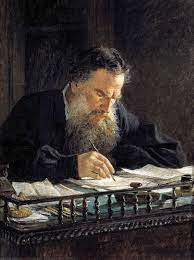
Blavatsky and Leo Tolstoy

Blavatsky, who wrote two articles about Tolstoy (The Science of Life, a lecture transcription review and Diagnoses and Palliatives, a review of his Kreutzer Sonata) and translated one of his short stories, The Imp and the Crust, felt a certain affinity with Tolstoy’s philosophical writings and spiritual ideas. Moreover, she sent him an inscribed copy of The Voice of the Silence, and he used eight sayings from them in his The Thoughts of Wise People for Every Day. According to Blavatsky :

''We have translated this rather lengthy fragment from the Report of Count Tolstoi’s superb lecture, because it reads like the echo of the finest teachings of the universal ethics of true theosophy. His definition of life in its abstract sense, and of the life every earnest theosophist ought to follow, each according to, and in the measure of, his natural capacities—is the summary and the Alpha and the Omega of practical psychic, if not spiritual life.'' (H.P. Blavatsky Collected Writings, Volume 8. THE SCIENCE OF LIFE [Lucifer, Vol. I, No. 3, November 1887, p. 240]

She ran a review of an article on Tolstoy by Raphael von Koeber "Leo Tolstoi and his Unecclesiastical Christianity" (Lucifer, September 1890) which states that :

For Tolstoi, Life means the striving of man after well being, after happiness, a happiness only to be attained, as we have seen, through the fulfillment of the commands of Jesus. Of these commands the deepest meaning is: true life, therefore also true happiness, consists--not in the preservation of one's personality, but--in absorption into the All, into God and Humanity. Since God is Reason, the Christian teaching may be formulated thus: subordinate thy personal life to reason, which demands of thee unconditional love for all beings.

And Blavatsky adds : ‘’Absolutely the same doctrine as that taught by Buddha and all other Initiates, Plato included. A fact recognised by Tolstoi, though not given its due significance by him.’’

Tolstoy’s concept of Universal Brotherhood was inspired by his reading of Schopenhauer and especially the ideas of Christian love, charity and fraternity in The Sermon of the Mount from the New Testament, although in A Letter to a Hindu he explains that : ‘’This thought appeared in most various forms at different times and places, with varying completeness and clarity. It found expression in Brahmanism, Judaism, Mazdaism (the teachings of Zoroaster), in Buddhism, Taoism, Confucianism, and in the writings of the Greek and Roman sages, as well as in Christianity and Mohammedanism.’’

A seminal architect of non-violent peace activism, in 1908, Tolstoy wrote A Letter to a Hindu outlining his belief in non-violence as a means for India to gain independence from colonial rule. In 1909, Gandhi read a copy of the letter when he was becoming an activist in South Africa. He wrote to Tolstoy seeking proof that he was the author, which led to further correspondence. It is interesting to note that Blavatsky had brief contacts with both men.